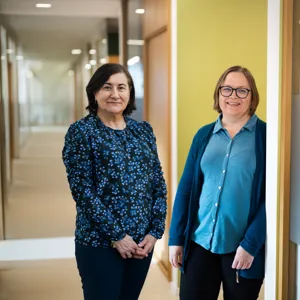
Node leaders: Aurora Martinez and Jannicke Igland
Aurora Martinez is a professor at the Department of Biomedicine, University of Bergen, and the head of the Biorecognition group. The research group investigates the molecular mechanisms underlying neurometabolic and neurological disorders, applying multidisciplinary and translational approaches. The Martinez Lab is a specialised screening site at the NOR-Openscreen and EU-Openscreen networks and has proficiency in biophysics, structural biology, drug design, cellular biology, and mouse disease models. The methodological expertise contributed to Neuro-SysMed includes target identification and characterisation, compound screening using both biophysical and cellular screens, and hit identification and expansion. In addition, they perform mechanistic validation of optimal hits and have a comprehensive knowledge of the progression from early-stage drug discovery to the identification of best leads for proof-of-concept, patenting, and the direct initiation of clinical trials for repurposed drugs. Their main focus in the centre is to develop preventive and corrective therapies for Parkinson’s disease (PD) and other Parkinsonian disorders, in collaboration with Charalampos Tzoulis.
Jannicke Igland is an associate professor in medical statistics at the University of Bergen with long experience from registry-based epidemiology, including pharmacoepidemiology. She leads the DRONE group – Drug RepurpOsing for NEurological diseases. The DRONE group harbours world-leading expertise in registry and epidemiology research. They focus on virtual drug screening, employing the Norwegian national registries to identify candidate drugs for repurposing for neurological diseases, including Parkinson’s (PD), ALS, multiple sclerosis (MS), and Alzheimer’s disease (AD).
Igland's team comprises the in silico branch of the Drug Discovery Node.
Node activities
Mitochondrial function
In collaboration with the PD Node, Aurora Martinez’s group has conducted a cellbased screening campaign to identify already approved drugs that can counteract the neuronal respiratory complex I (CI) deficiency observed in a subgroup of PD patients. One of the hit compounds identified by Researcher Kunwar Jung KC is a drug with the potential to enhance mitochondrial function, and it has shown promising results in enhancing mitochondrial CI protein levels and promoting mitochondrial biogenesis in dopaminergic cell models. Mechanistic studies have shown that the drug increases CI levels, mitochondrial biogenesis, and mitochondrial respiratory capacity, suggesting a potential therapeutic in PD, notably the CI-deficient subtype (Jung-KC et al., under reivew).
The project has recently received additional funding through a “Qualification” project from the Research Council of Norway (RCN; KOMMERSFORSK), which positions the team for a larger “Validation” project. They have also obtained funds from the Gerda Meyer Nyquist Legat and, recently, from the “Norges Parkinson Forskningsfond” (by Kunwar Jung KC), allowing them to advance the drug discovery efforts towards inclusion in clinical trials.
Tyrosine hydroxylase (TH) as a treatment target in PD and parkinsonisms
In a recent collaboration with the labs of Angeles García-Cazorla (Hospital Sant Joan de Déu, Barcelona) and Antonella Consiglio (Bellvitge University Hospital-IDIBELL, Barcelona), the team has discovered that supplementation with the TH cofactor tetrahydrobiopterin (BH4) increases TH+ cells and DA, and improves motor outcomes in a THD mouse model, highlighting the therapeutic potential of BH4 for specific TH variants in parkinsonisms (Jung-KC et al., 2024). Recently, the team has also identified DNAJC12 as the molecular HSP40 cochaperone that maintains TH stability and decreases its propensity to aggregate. The solved structure of the complex by Cryo-EM (Tai et al., 2025) is facilitating the discovery of stabiliser drugs of TH and the TH:DNAJC12 complex.
Registry-based drug screening
Igland’s group is conducting a comprehensive registry-based drug screening project, which involves screening of all prescriptions given to all Norwegians in the period 2004–2023. The prescription data (approximately 1 billion prescriptions) are linked to incident cases of PD, ALS, MS, and AD. The overall objective of the project
is to evaluate whether existing drugs (molecules) can be repurposed as an effective treatment. A full screen of drugs associated with PD-risk has been completed, and in collaboration with Professor Clemens Scherzer, director of The Neurogenomics Lab at Yale University, the group is currently validating 72 promising drugs using neurons from patient stem cells carrying the SNCA triplication linked to autosomal dominant PD.
In addition to identifying drugs associated with the risk of developing PD, the group has also done a screen to identify drugs associated with improved prognosis among persons with PD. The results from the prognosis-study were published in Neurology in 2025 with several promising findings. Based on results from the screening and a biological validation at Yale University, a patent application was submitted in June
2025. Julia Axiina Tuominen also defended her PhD thesis partly based on this screening in June 2025.
If the group succeeds in identifying drugs that can prevent or delay the development of PD, it is also important to identify a time-window for possible prevention and to identify persons with a high probability of later developing PD, who can benefit from preventive treatments. Because of this, the group has also started to use registry data to identify the start of the PD prodrome by comparing the frequency of GP-contacts and drug prescriptions between PD cases and controls in monthly intervals 10–15 years before PD-diagnosis. In collaboration with machine learning experts at the Department of Informatics, the group is also supervising three master's students in machine learning who are using various machine learning methods to develop prediction models for PD based on prescription data.
The methods used for PD have also been used for ALS, and a paper describing the ALS prodrome is currently under review and expected to be published in 2026. In 2025, the methods have also been expanded to MS as a part of the Horizon-funded EBV-MS project. Persons with severe EBV-infections have been identified through diagnostic codes for mononucleosis in registry-data. The team is currently using prescription data and diagnostic codes from GP-contacts to describe the time period between primary EBV-infection and MS diagnosis. They will also use prescription data for drugs used in this time-period to identify molecules associated with the risk of developing MS and with the time to MS-diagnosis. This can help understand the mechanisms for disease development and be used to identify possible new treatments.