Affordable MS Drug Equally Effective – Saves Norway NOK 500 Million Annually
A Norwegian–Swedish study, now published in the New England Journal of Medicine, shows that the low-cost drug rituximab is as effective as ocrelizumab, one of the most effective treatments available for multiple sclerosis (MS). At the same time, the use of rituximab saves the Norwegian healthcare system approximately NOK 500 million every year.
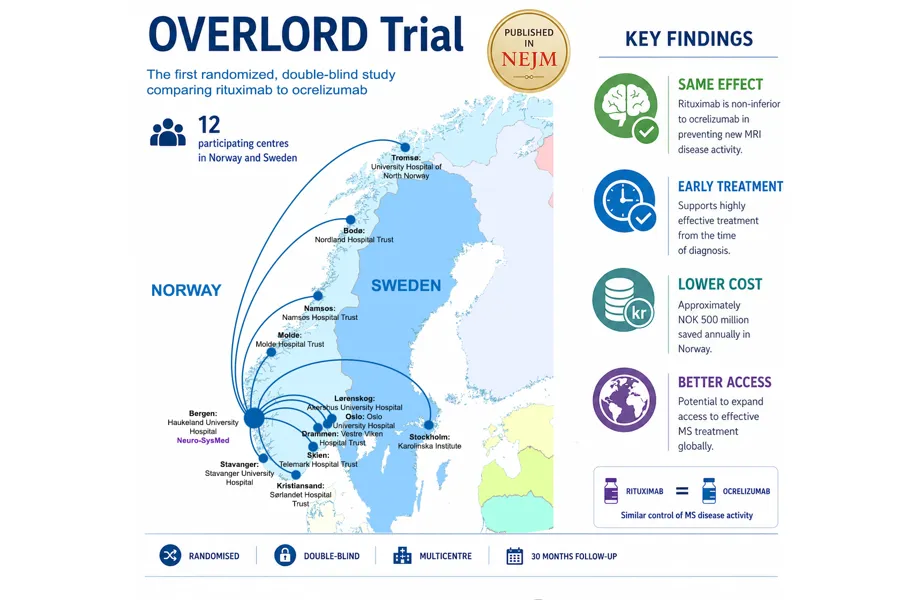
Illustration: Neuro-SysMed
NEJM is among the world's most prestigious journals in clinical medicine, and the study has already attracted considerable international interest.
“We show that it is possible to provide equally effective treatment at a much lower cost. That is rare in medicine,” says Professor and Consultant Neurologist Øivind Torkildsen from the University of Bergen and Haukeland University Hospital.

Photo: Neuro-SysMed, Eivind Senneset
The study was led from Neuro-SysMed, a Centre for Clinical Treatment Research at Haukeland University Hospital and the University of Bergen and demonstrates how publicly funded academic research can deliver substantial and direct benefits to society.
Equally Effective Treatment
The study is the first randomised, double-blind trial to directly compare rituximab and ocrelizumab in patients with newly diagnosed MS. Participants from across Norway and Sweden were enrolled and followed for 2.5 years through clinical assessments and MRI examinations.
The researchers found that rituximab was not inferior to ocrelizumab in preventing new disease activity detected by MRI. Both treatments maintained low levels of disease activity throughout the study.
The trial was designed to determine whether the two treatments were equivalent in effectiveness, not whether one was superior to the other.
Expanding Opportunities for Early Treatment
MS is a chronic disease in which the body's immune system attacks the central nervous system. Early and effective treatment is crucial for slowing disease progression.
“When highly effective treatment can be offered from the time of diagnosis to all patients, rather than being reserved for those with the most aggressive disease, it creates better opportunities for favourable long-term outcomes,” says Torkildsen.
A Norwegian Model with Global Significance
Norway was among the first countries to adopt rituximab on a large scale for the treatment of MS.
“This is a study to which the entire country has contributed, and it demonstrates what can be achieved through collaboration between public hospitals and research institutions,” he says.
The low cost of rituximab makes effective treatment accessible to many more patients, both in Norway and internationally.
“In many low- and middle-income countries, modern MS treatments remain unavailable because of their high cost. Our findings may help make effective treatment accessible to more people,” says Torkildsen.
Rituximab has recently been included in the World Health Organization Model List of Essential Medicines for the treatment of MS. Through their work within the Multiple Sclerosis International Federation, Norwegian MS experts have contributed to this international effort. Inclusion on the WHO list represents an important step forward, as it may improve access to effective MS treatment in countries with limited healthcare resources.
Contact
Øivind Torkildsen
Professor, University of Bergen
Consultant Neurologist, Haukeland University Hospital
Email: ofto@helse-bergen.no
Telephone: +47 906 17 206
About the Study
- Published in the New England Journal of Medicine: Rituximab versus Ocrelizumab in Newly Diagnosed Relapsing Multiple Sclerosis
- Randomised, double-blind, multicentre trial
- Compares rituximab and ocrelizumab in newly diagnosed MS
- Follow-up period: 30 months
- Publicly funded through KLINBEFORSK