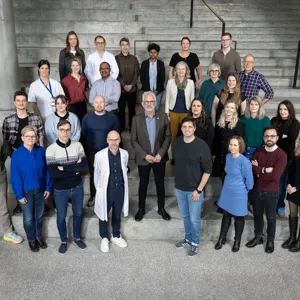
The MS Node has longstanding and internationally recognised research expertise ranging from basic immunopathological characterisation and preclinical animal studies to epidemiology, clinical course, imaging, clinical trials, health economics, and patient-reported outcome measures.
Under the leadership of Professor Myhr, the Group has focused on four research areas: Clinical Neurology and Biomarker Research (coordinated by Professor Myhr), Clinical Treatment Trials (coordinated by Professor Ø. Torkildsen), Epidemiology and Registry-Based Research (coordinated by Associate Professor S. Wergeland), and Pathology and Animal Models (coordinated by Professor L. Bø and Dr. C. Kvistad). The strong interdisciplinary research strategy has been sustained and has led to more than 40 PhD theses with significant contributions in clinical neurology, nursing, physiotherapy, epidemiology, social sciences, psychiatry, basic immunology, imaging, and proteomics. The group has initiated or participated in more than 50 clinical treatment trials and contributed to more than 550 scientific papers on various topics within multiple sclerosis.
As of August 2025, the group is led by Professor Torkildsen.
Node leaders: Kjell-Morten Myhr and Øivind Torkildsen
Kjell-Morten Myhr is a senior consultant and professor of neurology. Myhr has led the Bergen MS Research Group at Haukeland University Hospital and the University of Bergen since 2001. In August 2025, he transitioned to his current position as Vice-Rector for Research and Innovation at the University of Bergen. He has previously chaired the Norwegian MS Competence Centre, the Norwegian MS Registry, and the first KG Jebsen Centre for Medical Research (in MS). He is currently the deputy director of Neuro-SysMed.
Øivind Torkildsen is a professor of neurology at the University of Bergen and senior consultant at the Department of Neurology, Haukeland University Hospital, Norway. He leads the Bergen Multiple Sclerosis Research Group and serves as coordinator of the EU-Horizon project EBV-MS. He is the principal investigator in several national and international MS studies, including OVERLORD-MS and TAF-EBV. His research focuses on disease mechanisms, biomarkers, and clinical treatment strategies in multiple sclerosis, with particular emphasis on B-cell-directed therapies and Epstein-Barr virus-related pathogenesis.
Research Focus
The MS Node is addressing major challenges in MS therapy.Their primary focus is on optimizing treatment for relapsing-remitting MS by employing early, high-efficacy disease‑modifying therapies and stem cell therapy for patients who experience breakthrough disease activity. They also concentrate on the neurodegenerative component of progressive MS, and on the symptomatic management of pain, spasticity and sleep disturbances. More recently, they have begun exploring novel antiviral treatment targets aimed at both treating and preventing the disease.
The group was recently evaluated by the Research Council of Norway (RCN), and received the following description:
“The Bergen Multiple Sclerosis (MS) Research Group provides an outstanding environment for supporting the production of world-leading research which is comparable to the best work internationally in this area.”
The clinical impact case presented by the group received the following evaluation:
“This is an incredible story of clearly planned clinical research with an eye on improving patient outcomes and balancing this with a societal impact, as the licenced therapy is so expensive. Their approach has all the merits of good research governance, of national and international collaboration, and this is a fantastic example of clinical innovation that helps patients and society.”
Node activities
The MS Node has extensive experience in diagnosing and treating MS. Their ongoing research aims to define the significance of potential risk factors and biomarkers for prognosis and treatment response, with the goal of optimizing treatment strategies across different disease stages. Overall, the node aims to develop tailored treatment strategies for individuals with MS. Major challenges include maximizing the effectiveness of existing disease-modifying therapies and identifying new disease pathways that can be targeted by novel treatments, which is especially crucial for addressing the neurodegenerative component in progressive MS. In addition, they are developing new strategies for disease prevention. Currently, the MS Node is conducting 13 investigator-initiated and five industry-sponsored clinical trials.
See an overview of the MS Node clinical trials on the page MS and clinical studies.
Biomarker Studies
The MS Node is currently involved in immune phenotyping cells from patients included in ongoing clinical trials to identify biomarkers for treatment response. The goal is to define disease remission to tailor dosing, treatment duration, and patient selection for different therapies.
Additionally, they are studying the potential of extracellular vesicles as biomarkers for disease activity and response to B-cell depletion therapy in relapsing-remitting MS.
The node also conducts preclinical cell culture- and animal studies to evaluate possible disease pathways of progressive MS and the regenerative potential of stem cell therapy, as well as the role of microglia in these disease processes.
Treatment responses are further assessed using neurofilament biomarkers in both cerebrospinal fluid and serum. In collaboration with the Mohn Medical Imaging and Visualization Centre at Haukeland University Hospital, they evaluate treatment responses using magnetic resonance imaging (MRI).
MS-registry studies
The MS-registry part of the MS Node is conducting long-term safety studies of MS therapies and analysing real-world data on treatment compliance and factors influencing discontinuation rates for ongoing therapies. They are also evaluating the benefit of early high-efficacy treatment compared to an escalation treatment strategy.