Welcome to our new students: Anna and Xu
Anna and Xu, who are both studying Medical Technology at the University of Bergen, have their internships at PiV this autumn. Here they are further advancing the work on the AI tool that PiV is developing to identify pathological features in tubular lesions from kidney biopsies.
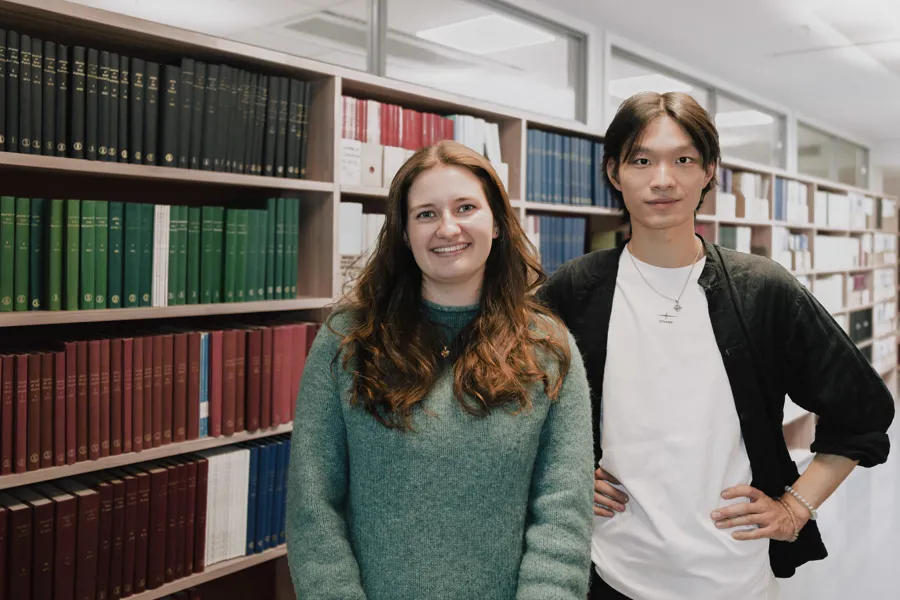
Hi! We are Anna and Xu, the new interns at PiV, and we are very excited to join the team this autumn! We will continue working on the AI model, which aims to support the diagnosis of chronic kidney disease (CKD) by making the analysis of kidney biopsies more efficient.
We are working with digital slides from kidney biopsies. Previous groups of MTEK interns have, in cooperation with the team here at PiV, been investigating kidney tubules with computational tools. By extracting patches containing single tubules, pre-processing them and utilizing different strategies for clustering, we continue this work and aspire to find meaningful groupings of the data. These groupings will allow us to classify the nature and extent of tubular damage.
We are currently advancing the project from 2 different angles. One of the current challenges is that the model places too much emphasis on characteristics such as the size, shape, and colour of the tubules. This can influence how the images are grouped and may prevent the model from recognising more subtle morphological features. Anna, a third-year MEDTEK student specialising in physics, is working on resolving this challenge. She will explore additional augmentation strategies to bring to light the underlying, more detailed morphological features to further refine the model. This process will consist of investigating, implementing, and testing a selection of such augmentation strategies. The goal is to achieve closer alignment between the model’s classification and the pathologists’ categories.
Technology continues to advance, and AI development is rapidly accelerating. AI advances and its use in the modern era span multiple fields. In medicine, Pathologists can use it to identify features in tubular images. Xu, a second-year MEDTEK student who specialises in chemistry, is trying to investigate if recently published models which were pre-trained on large-scale pathology image datasets would allow the extraction of image features that can help to distinguish between different types of morphological patterns among tubules. Accordingly, the testing strategy consists of evaluating and comparing various models, both within the group of pathology-trained models and against earlier models developed without pathology image data. The evaluation also explores how well the learned feature embeddings capture biologically relevant information, enabling tubules to be distinguished and clustered according to their known morphological characteristics.